Looking for Akitaya
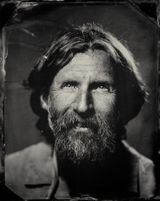
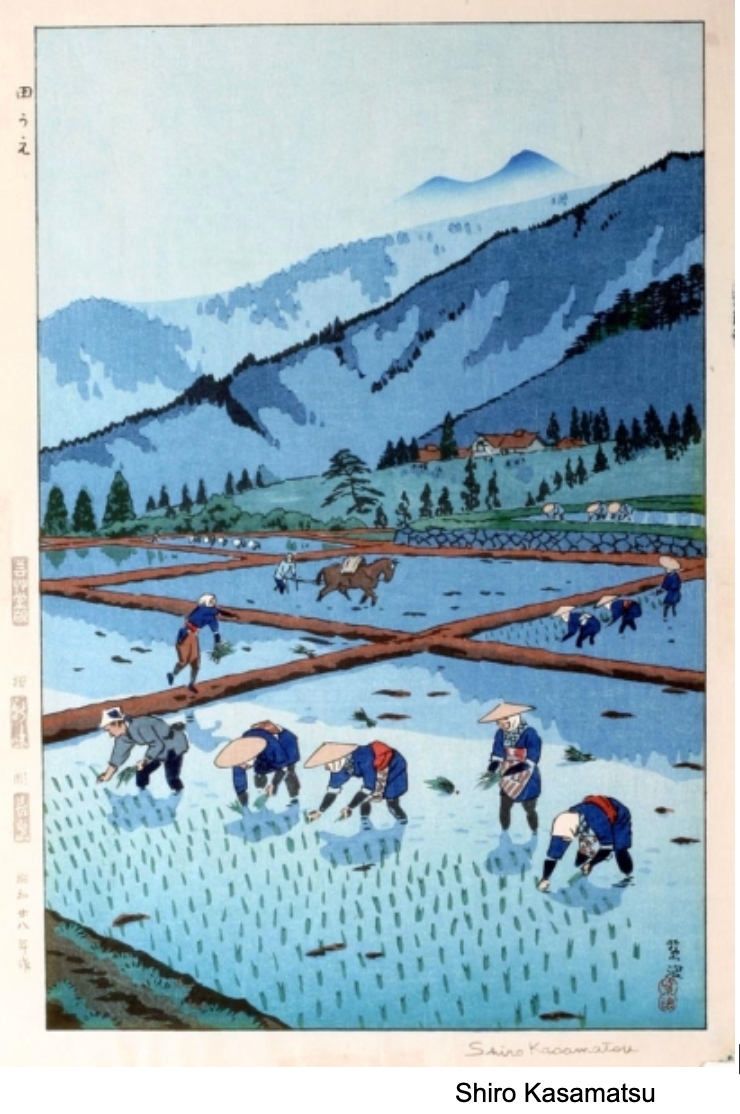
Even though I lived and skied in Japan (northern Honshu and Hokkaido) for a couple years in the early 1990s, I remain an outsider. I've been looking for Akitaya for quite some time.
Some history.
On April 2, 1961, a number of large ground avalanches broke out almost all over the mountain district of the southern Hidaka Mountain Range, Hokkaido, during a period of only half the day; one of them assaulted a workmen's house and killed 33 and injured 12 persons.
In 1965, an avalanche research station of the Institute of Low Temperature Science, Hokkaido University, was established at Toikanbetsu, Teshio mountain range in the northern Hokkaido. In this district, the average thickness of snow covers in the normal winter comes up to 1 m or so and depth hoar grows fairly actively in it; besides, a number of ground avalanches break out all over the south slopes of the mountain ridges in spring.
In 1974, Eiji Akitaya published one of the most comprehensive papers on facets and depth hoar, entitled, simply, Studies on Depth Hoar.
With respect to Paulcke, Seligman, Saito, de Quervain, Bader, LaChapelle, Colbeck, Perla, Jamieson (the list is a long and winding road) and others, perhaps the most comprehensive study of facets and depth hoar can be attributed to Eizi Akitaya. Akitaya received a PhD at Hokkaido University.
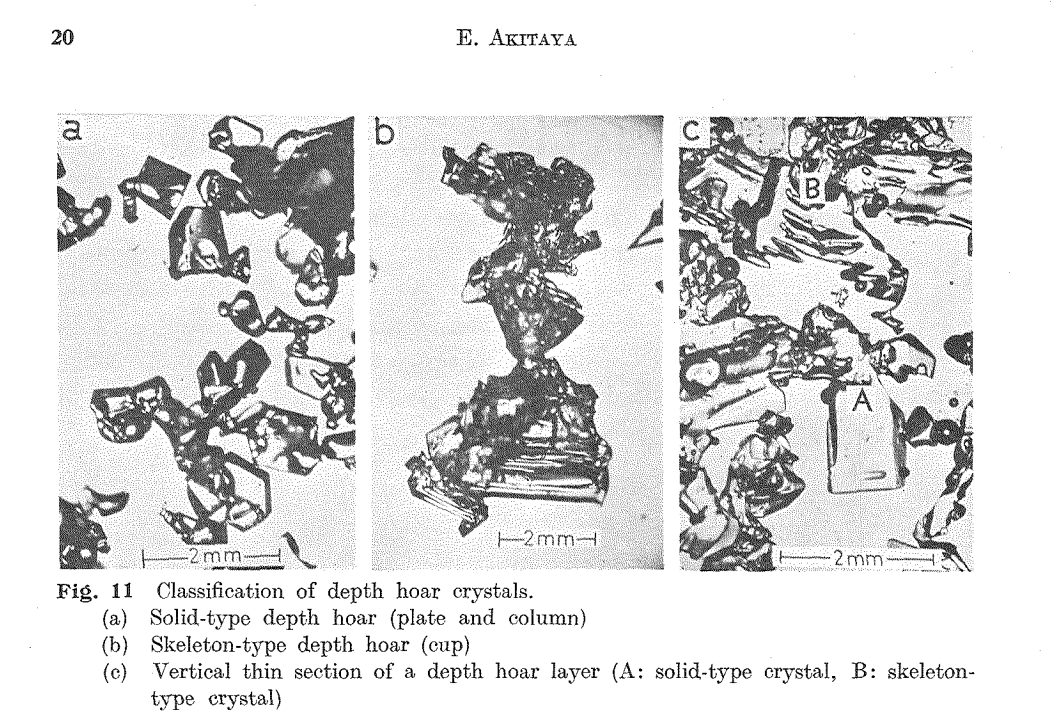
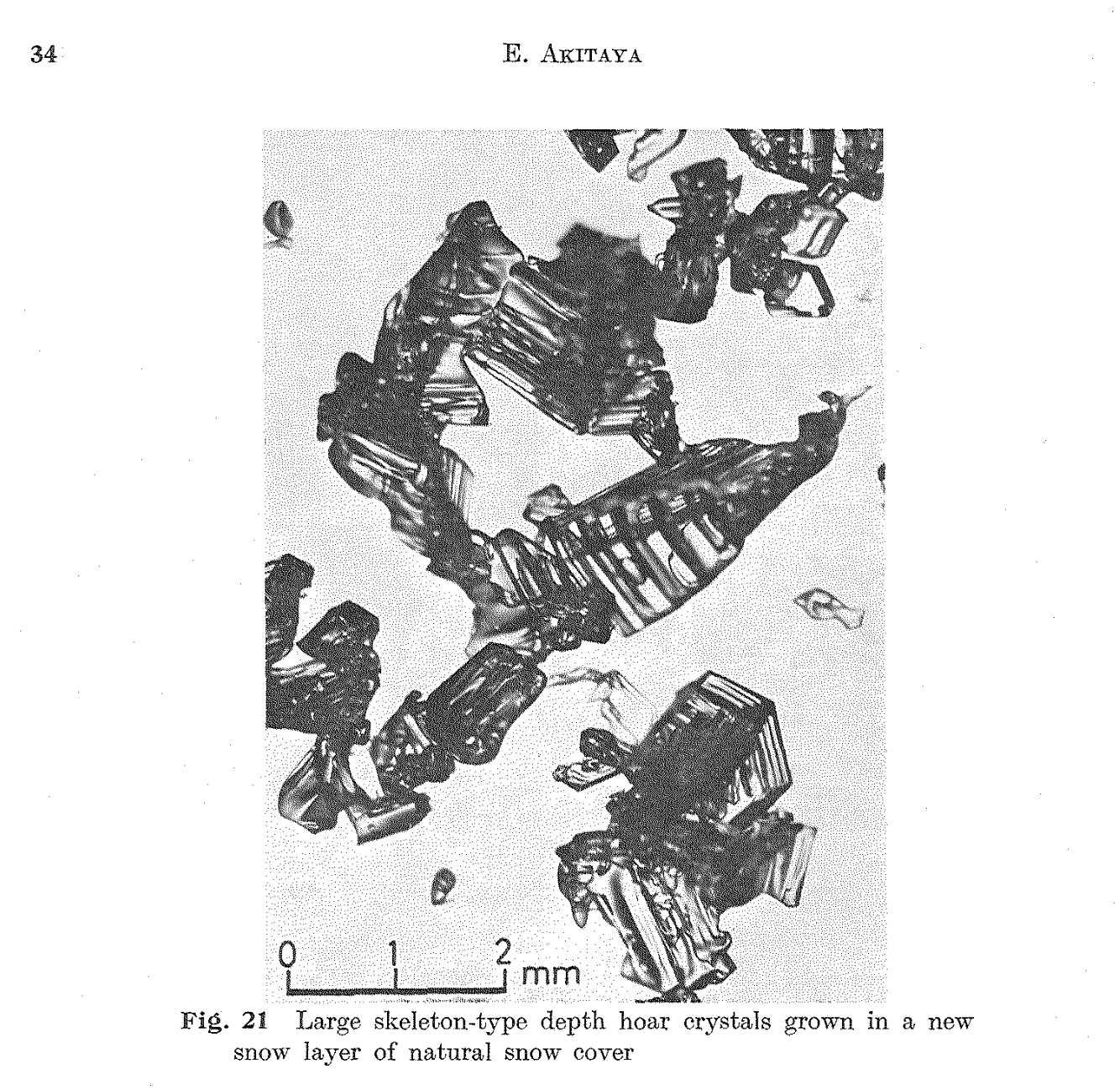
Akitya writes, Skeleton-type depth hoar (SHIMO-ZARAME-YUKI): Skeleton-type depth hoar is formed by a dry metamorphosis under a large negative temperature gradient in a snow cover. A hoar grain is a large-skeleton, rugged-surface crystal with thin joints at its base; it has cup, plate, needle, sheath, or sector shapes. Generally, this type of depth hoar layer is extremely fragile against a dynamic force.
...and there-in lies the rub: most of the avalanches that kill people in the West are avalanches that fail on a persistent weak layer of facets and depth hoar.
For now, though, Akitaya remains a mystery to me. It was only Perla who knew him to some degree -
very serious,
snow scientist ...
with a humble rural upbringing from N. Hokkaido,
where he back-packed 100 pound bags of rice.
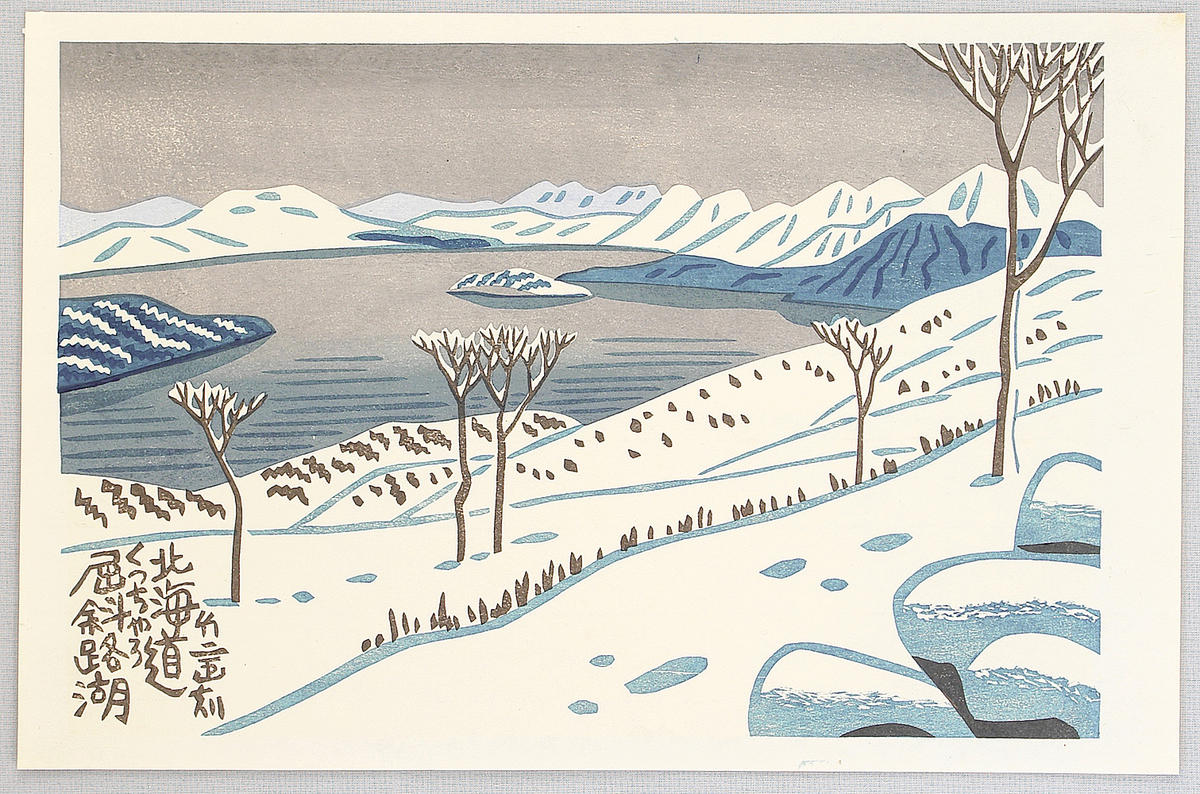
At this point, it's all conjecture. Was Akitaya born in northern Hokkaido during the era the Japanese referred to as the Greater East Asia War (大東亜戦争, Dai Tō-A Sensō)? Who was this humble rice farmer that fell in love with the snow? Did he have a favorite onsen to visit in the evenings after researching snow all day? Did he love the haiku of Basho the way I do?
I may have to return to Hokkaido to find the answers to these questions.