BOOK REVIEW - Making Decisions in Avalanche Terrain: Human Factors in Theory and Practice by Jerry Johnson & Jordy Hendrikx, review by Drew Hardesty

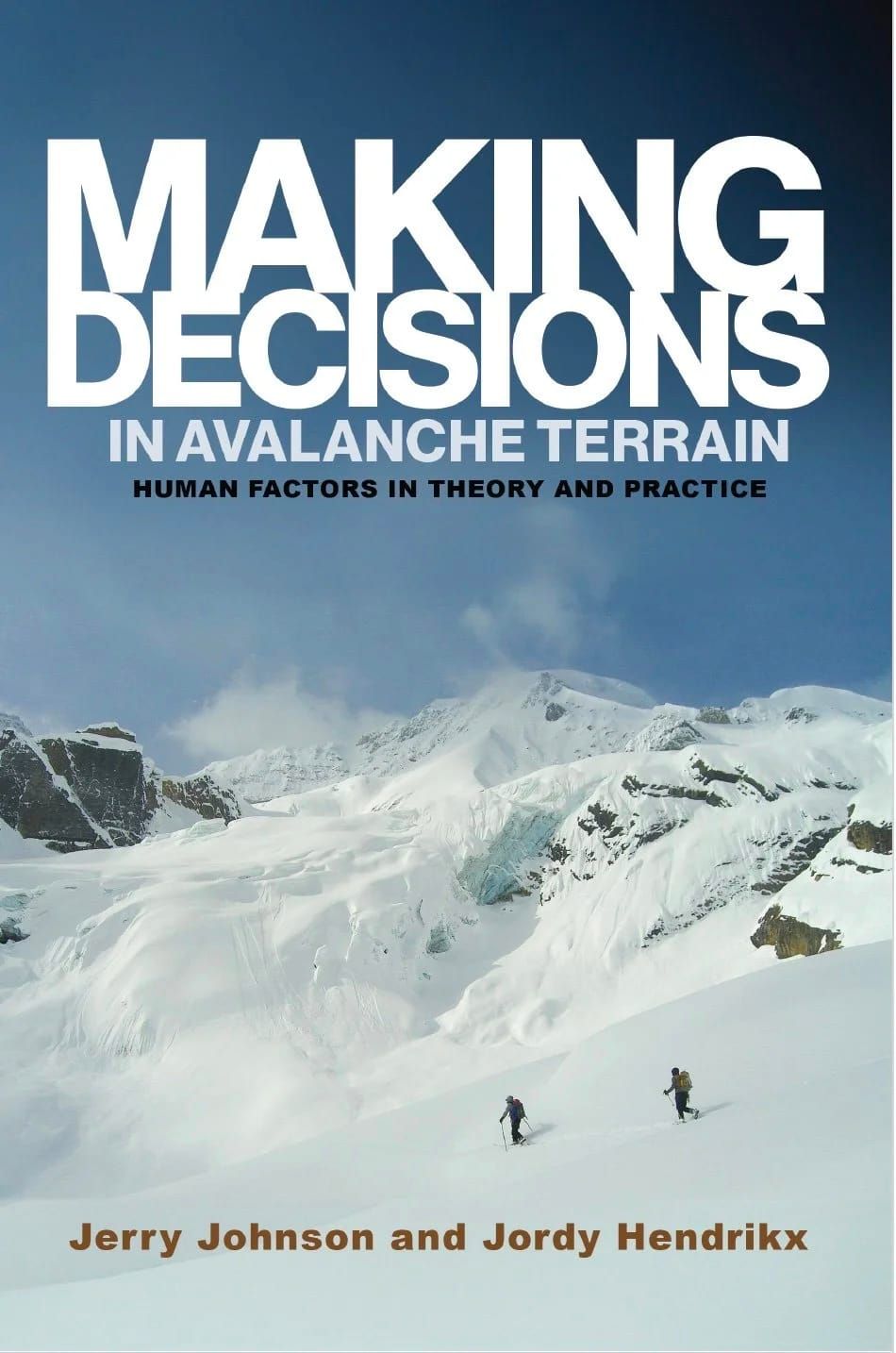
(previously published last winter in The Avalanche Review)
WARNING! Books like these are not for everyone. They’re only for people interested in how to make better decisions, not just in the alpine or the backcountry, but in our day to day lives.
There was an era when the conventional thinking was that if we knew everything there was to know about snow and avalanches, then there would be no more avalanche fatalities. This naturally led to rigorous academic research, courses of study, advanced degrees and hierarchical pursuits of knowledge.
This was well after Ed LaChapelle’s time, but even Uncle Ed—with a PhD of his own—knew that this was insufficient, because he also knew that Sir Francis Bacon’s dictum, “Knowledge is power,” was insufficient; that knowledge, power, agency—all these and more are only tools in the toolbox for—at last —wise decision making. There has always been a wide gap—insurmountable for many, ego being the primary insurmountable gap—between knowledge and shall we say, application of knowledge.
Also at play...We knew there was depth hoar at the base of the snowpack; we just couldn’t help ourselves.
And this is where Making Decisions in Avalanche Terrain: Human Factors in Theory and Practice, a new book from Montana State University profes-
sors/faculty members Jerry Johnson and Jordy Hendrikx, comes in. Perhaps it was grief, guilt, or something else, but the death of former student Olivia Buchanan became a touchstone for their work. And they write, “When Olivia died (in an avalanche), it was clear that passing on our professional training proved inadequate to keeping our students and friends safe. There must be a better way, we thought. Teaching snow science students to simply dig more pits is necessary but not sufficient—a lack of snow science knowledge was not the issue.”
And so, using this event as their lodestar, they introduce their book as such: “This little book is about learning how to use our knowledge, skills, and abilities to make good decisions while backcountry skiing and snowmobiling.”
They have their work cut out for them.
For 165 pages, Johnson and Hendrikx pull from psychology, economics, and neuroscience to help us understand how emotion, errors of judgement, misconceptions, bias, and other psychological variables can trip us up in making wise decisions in our lives. They drew from salient research from behavioral economics researchers and psychologists Thaler to Kahneman and Tversky, to the neuroscientist Eric Kandel. I should also point out that they are evenhanded, spelling out why heuristics, bias, and emotion have inherently kept us alive for millennia and should be maligned at one’s peril. Johnson and Hendrikx cite from their own research—on the influence of social media on decision making as well as their research on in-situ decision-making in the backcountry—to make their case.
There is a lot to learn and internalize here.
To be fair, I do think that the book could be pared down in some ways for the next edition...and expanded in other ways. For example, near the end, they offer some “Practical Tips for Decision Making in Avalanche Terrain.” But the tips—among them, looking at the distribution of early season snow coverage, practicing early and often with your rescue gear, continuing with your continuing education—are general tips for any recreationist or professional. Instead, it left me wanting a list, checklist, guide, or tips——as they tease—Practical Tips for Decision Making. They gloss over things with a few sentences in “Think About Your Level of Acceptable Risk,” when a full chapter might be dedicated to the subject. My own opinion—many (most?) people don’t really have a grasp of what is and what is not acceptable risk...or that they think they want to assume a high level of risk...up until the fall (ask any guileless trader in the stock market).
The big takeaway: At the end of the day, we are not skiers or snowmobilers, snowshoers or alpinists, but human beings making important and lasting decisions throughout our lives. Decisions about money, health, relationships, you name it. Everything that Johnson/Hendrikx and others brings to the table to help us make wise decisions is worthy of our time and consideration. I’d remind us of something Doug Krause has written in a previous essay in TAR, “We don’t need to be better avalanche people; we just need to be better people.” As such, Johnson and Hendrikx’s book is a worthy addition to a thin but growing canon and will sit right alongside Bruce Kay’s excellent Autonomy, Mastery, and Purpose in the Avalanche Patch.